by Chris | Apr 7, 2013 | Creative Projects
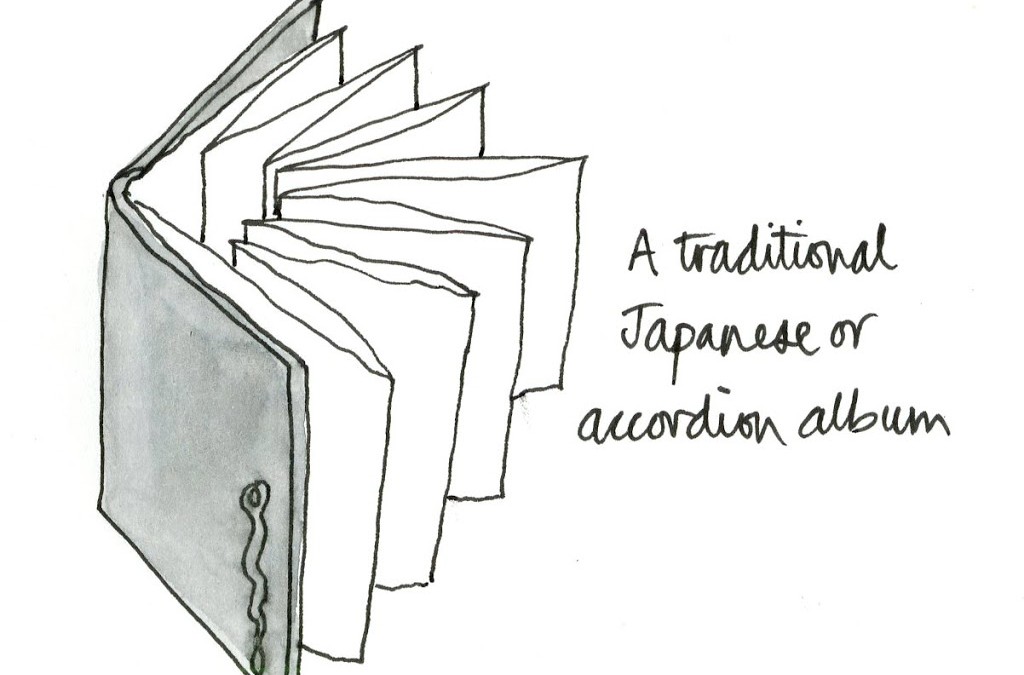
Creating a what? A Japanese album is sometimes known as an ‘accordion’ album, as the pages are joined zigzagging continuously throughout the book. This means that the whole album can be folded outwards to form one long strip of paper. Moleskine make them as small sketchbooks but I wanted to make my own for a very particular purpose. As from this month I have been invited to be the Artist-in-Residence at the Theatre, Chipping Norton for a period of one year. Having held a solo exhibition of paintings there early last year, I am very excited at the prospect of a cultural partnership with such a lively and vibrant creative centre as the Chippy Theatre! I know that as a part of this experience I want to record regular drawings and notes in a sketchbook to form a ‘diary’ or journal over the coming months, but in what form? It occurred to me that if I made a sketchbook in the form of a Japanese album then at the end of the year it could be unfolded and displayed as a whole which would surely be very dramatic. (Theatre-dramatic-see what-I-did?) Awesome thought. But the Moleskine ones, lovely as they are, are too small. The answer – as our house has always doubled as a Blue Peter studio – make my own! First of all the cover – two pieces of 2mm thin scrap mdf board cut to 190mm squares (that’s 7.5″ in old money). Cut a square hole in each and cover them (as shown in the first photo) with cotton fabric cut out of the back of a...
by Chris | Mar 28, 2012 | Chedworth Roman Villa, Cotswold Paintings, Creative Projects
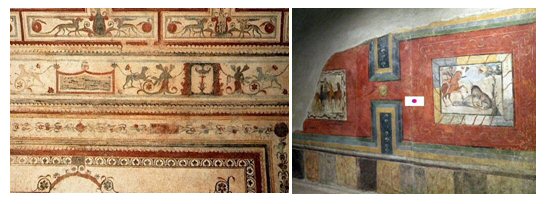
When a letter came through my door last Autumn inviting me to consider painting a wall in one of the most important Roman Villas in the country I was somewhat taken aback. What did I know about Roman Wall Painting? A major transformation project has been carried out at the Chedworth Roman Villa by the National Trust during the winter and as a part of the refurbishments a purpose built educational facility has been added on behind the café area. This will be known as the ‘Salway’ room and will provide schools and community groups with a dedicated and inspiring area in which to explore Roman life and culture at the Villa. It is having a recreation of a Roman Kitchen at one end, and an ‘eye-mat’ is being fitted on the floor digitally recreating some of the mosaics from the dining-room. That just leaves the walls and that’s where I came in. It was with some trepidation that I agreed to meet up with eminent Roman historian Professor Peter Salway and Dr. Rupert Goulding (National Trust curator at the Sherborne Park Estate), both consultants to the improvements on the site, along with Jane Lewis, the learning officer at the Villa. I had already bought a wonderful book I’d found on the internet ‘The Splendor of Roman Wall Painting’ by Umberto Pappalardo so I had done some homework, but the meeting was a steep learning curve. However they were all very encouraging and the exchange of ideas was stimulating, not to say a bit mind-boggling! I knew at this point that I had my work cut out. Examples of...
by Chris | Mar 7, 2007 | Creative Projects
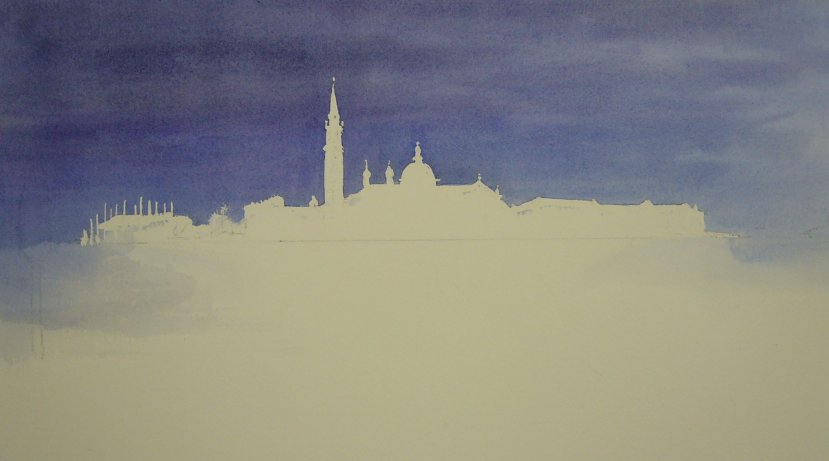
I’ve started a painting this week in my ‘classic’ watercolour style! By that I suppose I mean that the painting is carefully composed, with a preliminary pencil sketch (not shown here) to work out tonal values, composition and atmosphere. I love this view; of the island of San Giorgio Maggiore in Venice and have drawn and painted it before several times. But now I wanted to do something different, and it occurred to me that if I darkened the sky to have the buildings lighter than the sky, I could get feeling of strong late sunlight at the end of the day. I rarely use masking fluid, but here it comes into its own. By masking off the outline of the buildings, one can do more than several strong washes of colour in the sky, with no dabbling about, and the buildings will really stand out in front, as they would in a bold flash of sunlight. I didn’t do any preliminary drawing apart from the silhouette before painting the sky, just in case it all went pear-shaped and I had to start again! That’s from bitter experience! This time I was OK, and as you can see in the right hand picture, whilst waiting for washes of colour to dry, I have drawn in the gondolas in the foreground, painting one in first to work out what I liked, before committing myself to the rest. I’m looking forward to continuing tomorrow; its not in the bag just...
by Chris | Feb 16, 2007 | Creative Projects
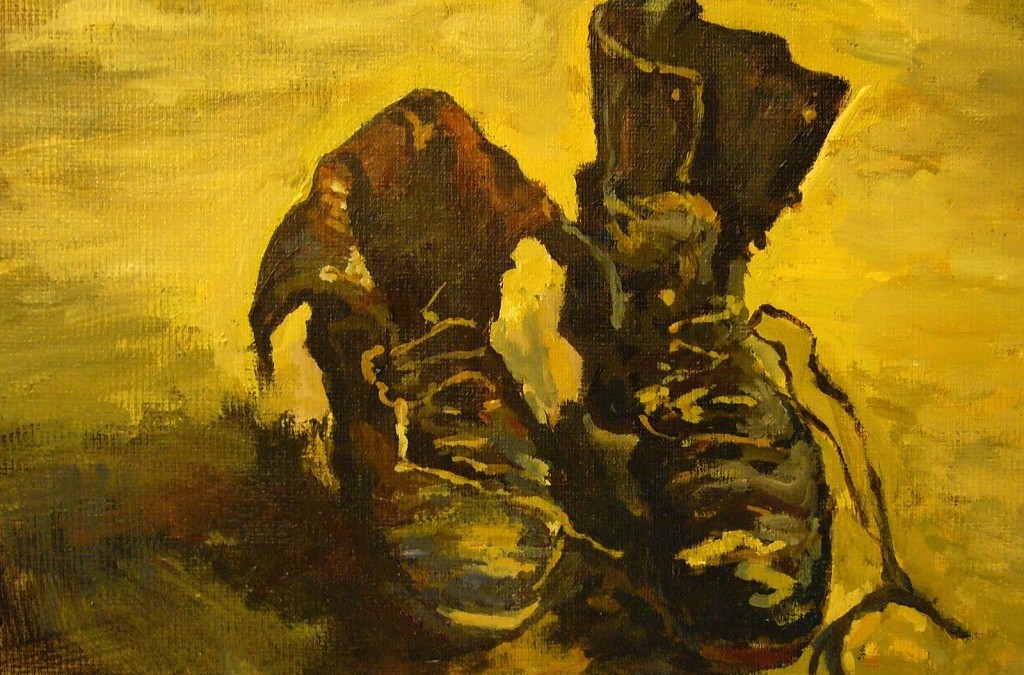
Where better to start ‘Travels with my Art’ than with Van Gogh’s boots? I know from experience how weary his feet must have been when he’d finished a day’s painting ‘en plein air’. The picture here shows a copy I made of Van Gogh’s original painting (from a postcard). I have just started painting in acrylics, after many years of watercolour as my main medium. Seeking inspiration one day, I saw the postcard on my wall, and made a copy. I did it in less than two hours, but am convinced that Van Gogh would have done it quicker. The brushtrokes are bold and quick, and I became bogged down in copying them all; he would have simply painted the boots. It gave me a good insight into his painting...